IsoMoDyn
—
Isomonodromic Deformations and Modular Dynamics
Première rencontre : Rennes 31 mars - 2 avril 2026
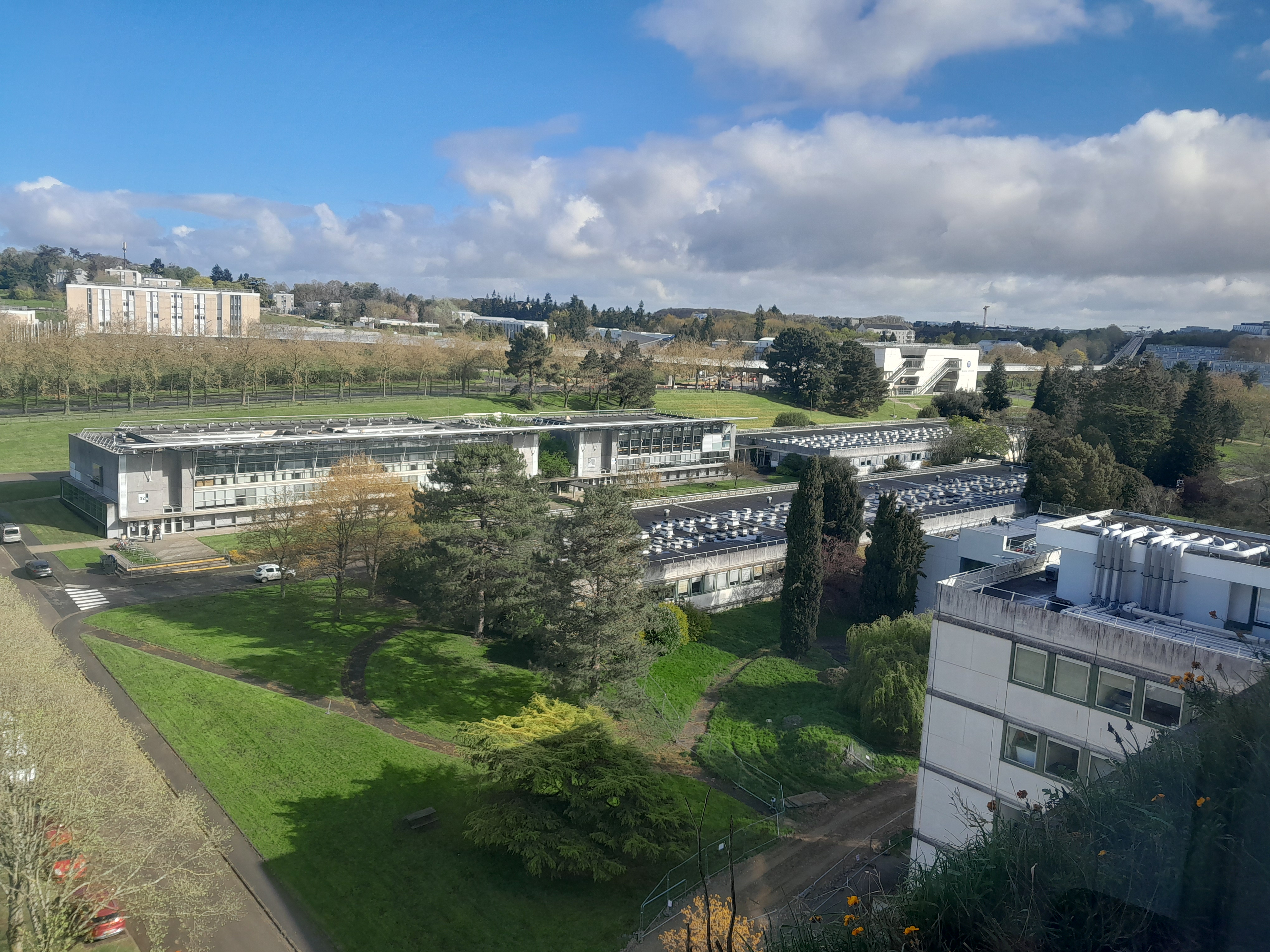 |
(sur la photo : bâtiment 32A / entrée tout à gauche / station Beaulieu Université métro B à droite / retour page IsoMoDyn)
Mardi 31 mars :
- 9h30-10h30 : Frank Loray : Introduction to Painlevé VI equation (1).
- 10h30-11h00 : pause café
- 11h00-12h00 : Sorin Dumitrescu : Sur la monodromie des systèmes différentiels holomorphes.
- 12h00-13h30 : pause repas
- 13h30-14h30 : Bertrand Deroin : Holonomie des métriques hyperboliques branchées sur les surfaces.
- 14h45-15h45 : Guy Casale : Relation algébriques entre solutions d'équations differentielles.
- 16h00-17h00 : Rémi Jaoui : Équations différentielles complètement désintégrées.
(17h00-18h30 : organisation des futurs événements)
Mercredi 1er avril :
- 9h00-10h00 : Frank Loray : Introduction to Painlevé VI equation (2).
- 10h00-10h30 : pause café
- 10h30-11h30 : Emmanuel Paul : Introduction aux variétés de caractères irrégulières.
- 11h30-12h30 : Mattia Morbello : Compactification of the fifth Painlevé foliation.
- 12h30-14h00 : pause repas
- 14h00-15h00 : Philip Boalch : Connections with poles in differential geometry.
- 15h15-16h15 : Carlos Simpson : De Rham type stacks and secondary monodromy.
(Resto 19h30 La Taverne de la Marine, place de Bretagne)
Jeudi 2 avril :
- 9h00-10h00 : Samuel Bronstein : Composantes compactes de variétés de caractères.
- 10h00-10h30 : pause café
- 10h30-11h30 : Inder Kaur : Parabolic bundles of rank 3 on elliptic curves.
- 11h30-12h30 : Florestan Martin-Baillon : Dynamique sur les variétés des caractères et cocycles au dessus des échanges d’intervalles.
- 12h30-14h00 : pause repas
- 14h00-15h00 : Seung uk Jang : Does Markov surface dream hyperbolic origami ?
- 15h00-16h00 : Arame Diaw : On the irreducibility of the Painleve 6 equations.
Participants
Hamza Bakhouch
- Delphine Boucher
- Samuel Bronstein
- Serge Cantat
- Guy Casale
- Dominique Cerveau
- Bertrand Deroin
- Arame Diaw (en ligne)
- Sorin Dumitrescu
- Gabriel Fazoli
- Antoine Fillaire
- Vincent Guirardel
- Michel Gros
- Gabriela Gutierrez
- Seung uk Jang
- Inder Kaur
- Frank Loray
- Florestan Martin-Baillon
- Mattia Morbello
- Guillerme Oliveira do Nascimento
- Emmanuel Paul
- Vincent Pecastaing
- Carlos Simpson
- Zeyang Wang
- Jinze Wu
Résumés
- Philip Boalch : Connections with poles in differential geometry.
The isomonodromy story is part of "differential algebraic geometry" (or "algebraic gauge theory"), attaching a nonlinear algebraic differential equation to a meromorphic linear differential system. The six Painleve equations are the simplest examples. For topologists and traditional differential geometers, isomononodromy (the theory of monodromy preserving deformations) is difficult since it involves meromorphic connections, i.e. connections with poles, and in turn the notion of "monodromy data" is generalized, leading to a generalization of the topological fundamental group, the Martinet-Ramis wild pi_1 (or its finitely generated slices, the wild surface groupoids). I'll describe some of the simplest definitions and constructions that have proved useful and inspiring in this story so far, leading up to the topological symplectic structures, the wild mapping class groups and some of the diagrammatic ways to classify isomonodromy systems (Stokes diagrams, fission graphs, global Cartan matrices). If time permits I'll discuss the two apps on my webpage illustrating the "wave-particle duality" of the theory (Stokes diagrams versus global Dynkin diagrams).
- Guy Casale : Relation algébriques entre solutions d'équations differentielles.
En 2004 K. Nishioka a montré que si y_1, \ldots y_n sont des solutions distinctes de la première équation de Painlevé alors y_1, \ldots, y_n, y'_1,\ldots, y'_n sont algébriquement indépendantes sur C(x). Ce résultat a été étendu a dautres equation de Painlevé par Pillay-Nagloo et Freitag-Nagloo.
J'expliquerai comment l'absence de structure géométrique "suffisamment riche" transverse au feuilletage sous-jacent à une équation différentielle permet de donner une description partielle des relations algébriques entre les solutions de cet équa.diff.
Je presenterai ce que l'on connait des structures géométriques transverse pour les équations de Painlevé.
- Bertrand Deroin : Holonomie des métriques hyperboliques branchées sur les surfaces.
J'expliquerai ce problème, un résultat de geometrisation obtenu en collaboration avec Nicolas Tholozan, et ses liens potentiels avec les feuilletages isomonodromiques et la conjecture de Bowditch.
- Sorin Dumitrescu : Monodromy of holomorphic sl(2,C)-differential systems.
We explain the framework, the motivations and the strategy behind a result that constructs holomorphic sl(2,C)-differential systems over
some Riemann surfaces X of genus g>1, such that the image of the associated
monodromy homomorphism lies in some cocompact Kleinian subgroup
G of SL(2,C). As a consequence,
there exist holomorphic maps from X to the quotient SL(2,C)/G, that do not factor through any elliptic curve. We also explain the construction of holomorphic sl(2,C)-differential systems with Fuchsian monodromy. This answers positively
questions asked by Huckleberry and Winkelmann and by Ghys.
The talk is based on joint work with Indranil Biswas (Shiv Nadar University, New Delhi), Lynn Heller (BIMSA, Beijing) and Sebastian Heller (BIMSA, Beijing).
- Arame Diaw : on the irreducibility of the Painleve 6 equations.
In this presentation, we will attempt to give a new proof of the irreducibility of the Painlevé 6 equations using a new approach through the geometry of holomorphic webs and symplectic geometry.
- Seung uk Jang : Does Markov surface dream hyperbolic origami ?
This talk illuminates the dynamics of Markov surfaces in a tropical point of view. If we model points of Markov surface "at the infinity" by curves diverging to infinity in a polynomial speed, the equation of Markov surfaces restricts the degrees of polynomial growths. All valid degree triples form a certain piecewise linear shape in R^3, called the skeleton of the Markov surface. This is a subset of so-called tropicalization of the surface.
The symmetries of the Markov surface induce a piecewise linear action on the skeleton. Depending on the scale of coefficients, such an action can be modeled by either a linear action on the usual plane modulo antipodes, or an isometric action on the hyperbolic plane. Both cases can be understood by "folding" the skeleton in a certain way, which is rather like folding the space in the hyperbolic metric. One image to have in mind is the Farey tessellation on the Poincaré disk.
We remark on how this idea can be precised, using non-archimedean fields, and announce some dynamical consequences in the non-archimedean context.
- Rémi Jaoui : Équations différentielles complètement désintégrées.
Une équation différentielle est complètement désintégrée si tout ensemble de solutions distinctes de l’équation est indépendant. Cette propriété est vérifiée par les équations de Painlevé à paramètres génériques et (presque tous) les systèmes de Lotka-Volterra.
Le but de mon exposé est de présenter des techniques de théorie des modèles et d’algèbre différentielle qui permettent d’établir cette propriété.
- Inder Kaur : Parabolics bundles of rank 3 on elliptic curves.
Moduli spaces of parabolic vector bundles on smooth curves of genus g>1
have been studied for decades and lot is known about their geometry. However, in the case
of small genus and rank >2, many questions are still open. In this talk, I will discuss
the geometry of the moduli space of semi-stable parabolic bundles of rank 3 and degree 0
on an elliptic curve and Torelli type results. This is joint work in progress with
Roberto Alvarenga and Frank Loray.
- Frank Loray : Introduction to Painlevé VI equation.
We will explain how Painlevé VI equation arises in the work of Painlevé,
and after as isomonodromic equation following Fuchs. We introduce the Riemann-Hilbert
correspondance, and explain how to derive Painlevé property. We discuss some topics
arising from Painlevé foliation.
- Florestan Martin-Baillon :
Dynamique sur les variétés des caractères et cocycles au dessus des échanges d’intervalles.
Les variétés de caractères sont des espaces classifiant les représentations d’un groupe dans un autre, à conjugaison près. Ils apparaissent naturellement dans de nombreux problèmes d’origines géométriques et dynamiques.Ces variétés de caractères ont un groupe de symétries naturelles (le groupe modulaire pour les groupes fondamentaux des surfaces), et on peut s’intéresser à l’action de ce groupe.
Cette action est riche d’un point de vue dynamique. Nous expliquerons d’abord que cette dynamique est très chaotique, et assez bien comprise, quand le groupe d’arrivée est compacte, puis nous présenterons un programme et des résultats qui visent à comprendre cette dynamique quand le groupe d’arrivé est PSL(2,R), en utilisant des techniques qui viennent de la renormalisation des échanges d’intervalles.
- Mattia Morbello : Compactification of the fifth Painlevé foliation.
Connections of Painlevé five type are a particular class of rank 2 irregular connections on the Riemann sphere with prescribed polar divisor. Their moduli space comes with a natural one-dimensional foliation whose leaves contains connections sharing the same monodromy representation. This foliation is induced by a classical differential equation, called Painlevé V equation. The goal of this talk is to present a suitable compactification of the moduli space in order to study the asymptotical behavior of the leaves in the boundary components.
- Emmanuel Paul : Introduction to irregular character varieties.
We want here to extend the Painlevé VI character variety to the other Painlevé equations. Starting from the main properties of an irregular singular point of a meromorphic connection, I will present the construction of the corresponding wild fundamental groupoids. I will focus on the morphisms between them in order to obtain the confluent morphisms between all the Painlevé character varieties.
- Carlos Simpson : De Rham type stacks and secondary monodromy.
Abstract: Given a smooth complex algebraic variety X, we can form the de Rham stack X_{dR} and there are also various related stacks. Connections and Higgs fields correspond to fibrations over these stacks. We can use these to get secondary classes including secondary Kodaira-Spencer maps and secondary local monodromy for higher dimensional degenerations using semistable reduction theory.